 Skip to content

Introduction
Securing these dynamic environments has become critical as more businesses migrate their infrastructure to the cloud. However, there’s often confusion between cloud scanning and cloud pentesting. While both are vital parts of a robust cloud security program, they serve very different purposes and should not be seen as interchangeable.
In this blog, we break down what each approach entails, how they differ in scope and methodology, and when to use one over the other. We’ll also walk through real-world scenarios and detailed methodologies to give you a practical understanding.
Who Is This Blog For?
This blog is crafted for cloud security professionals, DevOps teams, system administrators, red teamers, and compliance auditors. If you’re managing cloud-native applications on platforms like AWS, Azure, or GCP, or if you’re responsible for maintaining your organization’s cloud security posture, this blog is for you.
Whether you’re designing infrastructure-as-code, responding to security incidents, or preparing for compliance audits like SOC 2 or ISO 27001, knowing the difference between cloud scanning and pentesting will help you take the right action at the right time.
What Is Cloud Scanning?
Cloud scanning is an automated, rule-based process for detecting known vulnerabilities, configuration errors, and compliance violations in cloud environments. It’s often performed using CSPM (Cloud Security Posture Management) tools such as Prisma Cloud, AWS Inspector, Microsoft Defender for Cloud, or Wiz.
Methodology of Cloud Scanning
- Asset Discovery: The scanner identifies all cloud resources using API calls to the cloud provider (like AWS EC2, IAM, S3, etc.).
- Baseline Configuration Check: Scanned against best practices or compliance standards like CIS Benchmarks, NIST 800-53, PCI-DSS, or ISO 27001.
- Vulnerability Enumeration: The tool checks for exposed services, insecure ports, weak encryption, public access to buckets, IAM policy issues, and more.
- Reporting: Dashboards present identified issues, ranked by severity, with recommended remediations.
Real-World Example
Imagine an organization that manages sensitive user data in AWS S3 buckets. A CSPM tool detects a publicly accessible bucket containing PII. The scanner flags this misconfiguration and notifies the security team before any data leakage occurs.
However, if this bucket were paired with weak IAM roles, the vulnerability could escalate: a risk only uncovered by a pentester.

What Is Cloud Pentesting?
Cloud penetration testing involves a human-led assessment that simulates real-world attack scenarios. Unlike scanning, pentesting does not rely solely on known vulnerabilities—it explores logical flaws, business logic abuses, escalation paths, and chained attacks.
It typically includes attacking cloud applications, storage, identity configurations, and internal APIs through the lens of a motivated attacker.
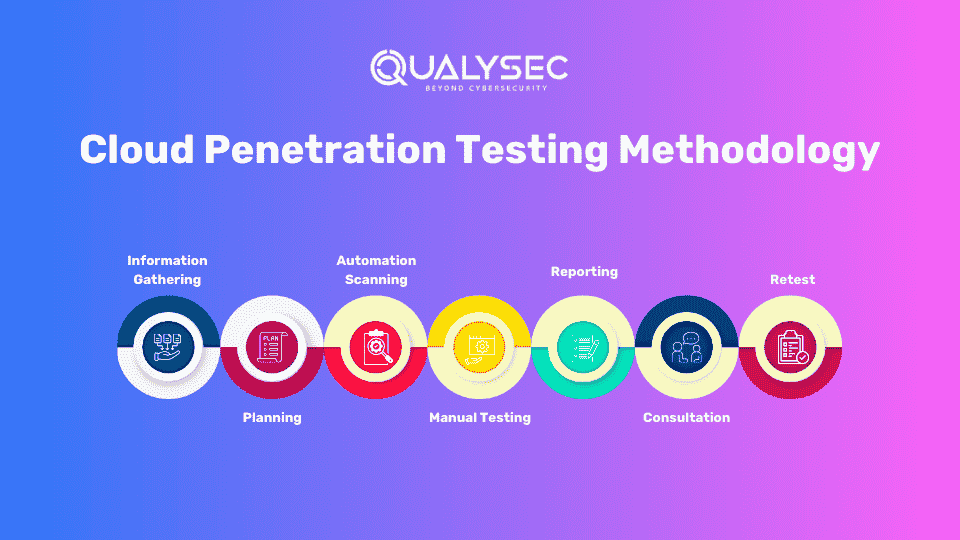
Methodology of Cloud Pentesting
Here’s a typical methodology followed during a cloud pentest:
- Scoping & Information Gathering:
Define in-scope assets (e.g., AWS account, Azure subscription), services used, IAM structures, and data flows. Gather initial intelligence using open-source intelligence (OSINT), WHOIS records, and cloud metadata endpoints. - Enumeration & Reconnaissance:
Use tools like Pacu (for AWS), ScoutSuite, or CloudBrute to map exposed cloud services, buckets, databases, and serverless functions. - Misconfiguration Exploitation:
Test for IAM misconfigurations, privilege escalations (e.g., exploiting overly permissive roles), exposed credentials, and service trust abuses. - Lateral Movement:
Move between services/accounts using obtained permissions—e.g., using STS to assume roles across accounts. - Persistence & Data Access:
Create rogue users or exploit service tokens to maintain access, followed by accessing sensitive data in storage or databases. - Reporting & Recommendations:
A comprehensive report is generated with findings, attack paths, PoCs, risk impact ratings, and remediation steps.
Real-World Example
A company uses AWS Lambda to run backend processes. A pentester discovers that the Lambda execution role has full administrative access, allowing them to create new IAM users, elevate privileges, and gain persistent access. This would never be detected by a scanning tool because the permission isn’t inherently “vulnerable”—but it’s dangerous in context.
Comparing Cloud Scanning and Pentesting
| Category | Cloud Scanning | Cloud Pentesting |
| Goal | Identify known issues and compliance gaps | Simulate real-world attacks |
| Methodology | Automated via API & tools | Manual + automated tools and scripts |
| Scope | Limited to predefined rules | Unlimited, based on the attacker’s creativity |
| Frequency | Continuous or on schedule | Performed periodically |
| Skill Level | Basic cloud security knowledge | Advanced cloud exploitation expertise |
| Tools | Wiz, Prisma, AWS Security Hub | Pacu, ScoutSuite, Prowler, custom scripts |
When Should You Use Each?
Use Cloud Scanning When:
- You need continuous visibility into your cloud security posture.
- You’re maintaining compliance standards (e.g., PCI, HIPAA).
- You’re in the early stages of cloud adoption and want quick wins.
Use Cloud Pentesting When:
- You need to simulate real-world attacks against your environment.
- You’re conducting a red team exercise or internal audit.
- You want to test your incident response capabilities.
You’re about to undergo a security certification or M&A due diligence.