 Skip to content

Let’s cut the corporate jargon. In offensive security, 2025 isn’t about if AI changes vulnerability assessment and penetration testing [VAPT]; it’s about acknowledging that the threat landscape is now running at machine speed. If you’re still selling a static, three-week pen test, you’re selling a false sense of security that the adversary will exploit in hours.
AI is the force multiplier. It’s the drone. We are still the architects.
The Adversary is Already Weaponized
The biggest shift? Velocity.
Criminal groups are now using generative AI to churn out hyper-personalized phishing campaigns and polymorphic malware that constantly rewrites itself. Traditional vulnerability scanners—the bread and butter of your basic VA report—are losing relevance against threats that can mutate their own signatures on demand.
This speed is why VAPT must move from periodic testing to continuous, real-time validation. You can’t wait for a quarterly report when an AI can exploit a cloud workload the moment it’s deployed.
New Attack Surface, New Targets
CISOs in 2025 are worried about something they weren’t even thinking about three years ago: the security of their internal AI agents.
These are the new, target-rich attack surfaces.
We’re no longer just hunting SQL injection. We’re testing for:
- Prompt Injection (LLM01): manipulating a model through crafted inputs to force unauthorized behaviors.
- Excessive Agency (LLM08): giving an LLM too much operational power without proper guardrails.
Example:
This is specialized, adversarial AI testing, requiring a deep understanding of model reasoning—not just network protocols. If you can’t test an LLM, you’re missing 2025’s biggest breach vector.

Fig: Model is only able to answer specific information

Fig: Demonstrates how a prompt injection attack can force the model to provide information about an unrelated topic that it is not intended to disclose
AI as the High-Speed Recon Drone
Forget the hype about “autonomous hacking.” AI is a phenomenal tool for two things: speed and volume. We use it as our high-speed reconnaissance drone.
- Initial Scan & Recon: AI tools can instantly map massive attack surfaces, perform OSINT collection, and run the “Quick Health Scan” that finds all the low-hanging fruit (outdated versions, default configs).
- Safe Validation: It can perform automated, “safe exploit validation,” proving that a vulnerability is real and exploitable without causing a production incident.
The following example shows how AI can be used to gather subdomains and increase the attack surface.
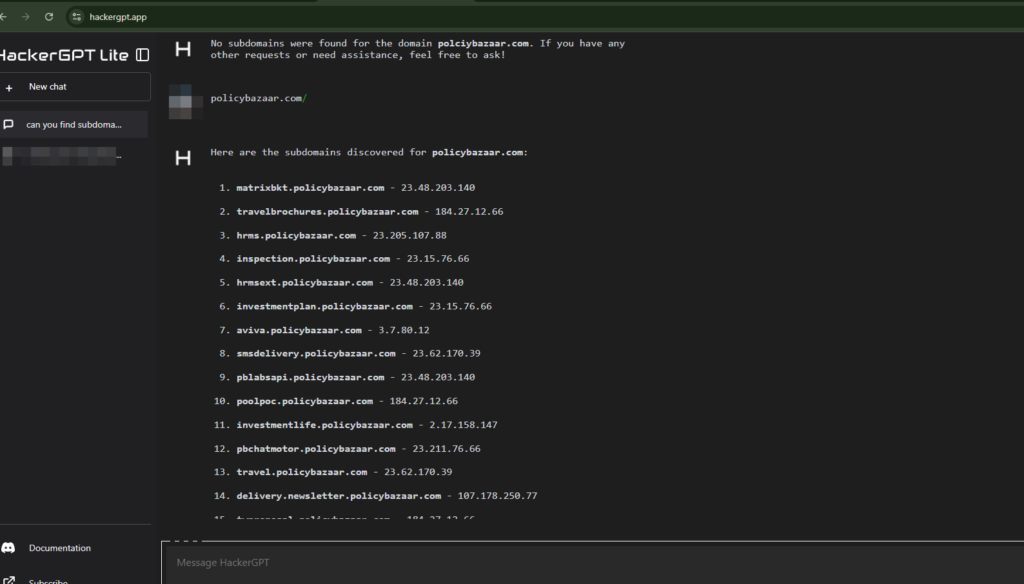
Fig: Showing enumeration subdomains using AI
This automation commoditizes the basic Vulnerability Assessment function. It removes the grunt work, freeing up our most valuable resource: the human brain.
The Human Advantage: Creativity and Context
Here is the cold reality that the automated platforms can’t touch: AI lacks creativity, intuition, and contextual understanding.
A machine can find 100 known CVEs. A human can combine three low-severity flaws—a misconfigured admin panel, a weak password policy, and a custom-built business logic flaw—to achieve total system compromise. This vulnerability chaining is where the real risk is proven and where zero-day discovery happens.