 Skip to content

Over the past month, security teams have been quietly circling the same topic: Ni8mare (CVE-2026-21858)—a high-impact vulnerability affecting n8n, the open-source workflow automation platform that has become a staple in engineering, data, and operations teams.
This hasn’t been loud, ransomware-style chaos. Instead, it’s been the kind of issue that shows up in post-incident reviews and uncomfortable audit conversations. The kind where everyone thought the tool was “internal,” “low risk,” or “just automation.”
As someone who reviews real production environments for a living, that framing is exactly the problem.
Why n8n keeps showing up in real environments
n8n sits in a deceptively powerful position:
- It orchestrates workflows across SaaS platforms
- It stores API tokens, secrets, and credentials
- It often runs with broad network access
- It’s frequently self-hosted with minimal hardening
In many organizations, n8n isn’t owned by security or platform teams. It’s spun up by engineers or ops teams trying to move fast—sometimes in a cloud VM, sometimes in Kubernetes, sometimes exposed “temporarily” for convenience.
That context matters when you look at Ni8mare.
What CVE-2026-21858 actually is (without the hype)
At a high level, Ni8mare is a vulnerability that allows an attacker to abuse how n8n processes and executes workflow logic, potentially leading to unauthorized access or execution within the n8n runtime context.
This is not a bug that magically breaks the internet on its own. It becomes dangerous when combined with common deployment patterns:
- Internet-exposed n8n instances
- Weak or misconfigured authentication
- Over-privileged workflow credentials
- Lack of network segmentation
In other words, Ni8mare doesn’t introduce a new class of risk. It amplifies existing ones that teams routinely underestimate.
That’s why it matters.
Exploitation
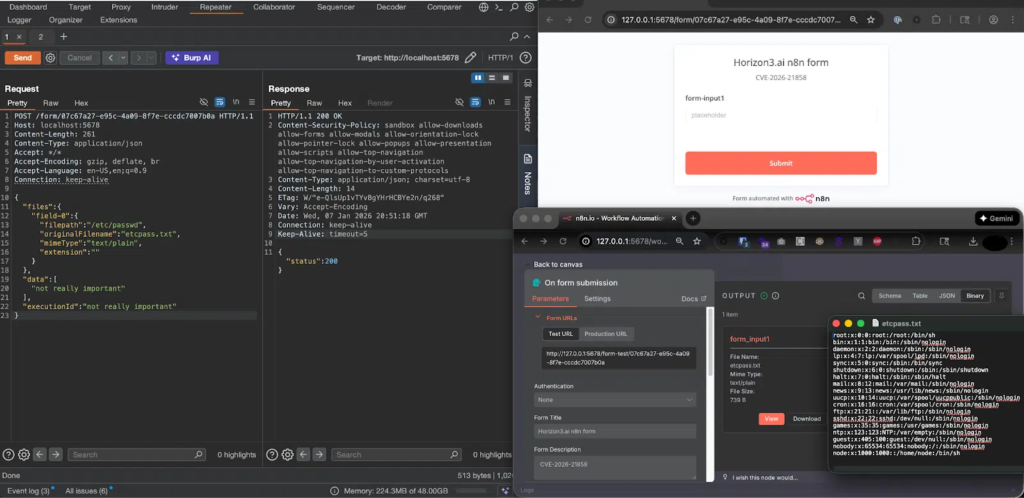
The Nuclei engine, developed by ProjectDiscovery, provides a robust framework for identifying CVE-2026-21858 across thousands of targets. Once an attacker finds an n8n form and successfully sends a POST request, they still need a mechanism to download or view the file contents. In the attached screenshot, the file ‘etcpass.txt’ can be downloaded by an authenticated user in the n8n workflow’s executions section.
Why this vulnerability is dangerous in production—not theory
In real environments, n8n is rarely isolated. It’s usually wired into:
- Git repositories
- Cloud provider APIs
- CI/CD systems
- Databases
- Internal admin APIs
- Slack, email, ticketing, and monitoring tools
When a workflow engine like n8n is compromised, the blast radius isn’t the host—it’s everything the workflows can reach.
During assessments, we consistently see:
- Long-lived API tokens stored in plaintext
- Workflows running with service-level credentials instead of scoped access
- No audit logging on workflow changes
- No alerting on workflow execution anomalies
Ni8mare turns those weaknesses from “theoretical risk” into something very real.
The mistakes that made this exploitable
The vulnerability itself is only half the story. The other half is how n8n is commonly deployed.
Treating automation platforms as “internal tools”
Internal does not mean safe.
Many n8n instances are:
- Publicly reachable
- Protected only by basic auth or weak credentials
- Sitting behind shared load balancers with no IP restrictions
Once exposed, any flaw in workflow handling becomes significantly more dangerous.
Over-trusting workflows with broad permissions
Automation is supposed to reduce human error. Instead, we often see it accumulate privilege.
Workflows that:
- Can write to production databases
- Rotate secrets
- Trigger deployments
- Access customer data
…are rarely reviewed with the same rigor as application code.
No ownership, no monitoring
Ask who owns n8n in most organizations and you’ll get vague answers.
That leads to:
- Missed security updates
- No version visibility
- No anomaly detection
- No incident response plan if automation is abused
Ni8mare exposed how fragile that model is.
Why this matters to compliance teams too
From a compliance perspective, Ni8mare touches multiple control areas:
- SOC 2: Access control, change management, system monitoring
- ISO 27001: Asset management, least privilege, secure configuration
- Internal audits: Shadow IT and undocumented systems
If n8n workflows can modify production systems or access regulated data, then n8n is in scope, whether it was intended to be or not.
Several organizations only realized this after auditors started asking uncomfortable questions.
What responsible remediation actually looks like
This is not about panic patching or ripping out n8n.
Effective remediation usually involves a combination of technical fixes and operational discipline.
Start with exposure reduction
- Remove public access unless absolutely required
- Enforce strong authentication (SSO where possible)
- Restrict network access to trusted sources
Re-evaluate workflow privileges
- Rotate and scope credentials used by workflows
- Separate high-risk workflows from low-risk automation
- Treat workflow definitions as code, not configuration
Add visibility and accountability
- Enable logging for workflow changes and executions
- Assign clear ownership for automation platforms
- Include n8n in vulnerability management and patch cycles
Align with security governance
- Document automation platforms in system inventories
- Map workflows to data classification levels
- Include automation tools in threat modeling exercises
None of this is glamorous. All of it works.
The broader lesson Ni8mare exposes
Ni8mare isn’t just about n8n.
It’s about how modern environments blur the line between applications, infrastructure, and automation. Workflow engines are now control planes. When they fail, they fail loudly and sideways.
Security teams that treat automation as “someone else’s problem” are going to keep seeing surprises like this.
The organizations that handled Ni8mare best weren’t the ones with the fastest patches—they were the ones that already understood what their automation could do.
Final thoughts
Ni8mare (CVE-2026-21858) will fade from headlines. Another vulnerability will replace it.
What won’t fade is the underlying issue: automation platforms are powerful, under-secured, and often invisible to governance processes.
If this vulnerability prompted you to take a closer look at your workflow tooling, that’s a good outcome. Most breaches don’t come from exotic zero-days—they come from familiar systems nobody thought to question.
How we help
At SecurifyAI, we work with engineering and security teams to assess real-world risk in automation platforms, CI/CD pipelines, and internal tooling—without disruption or finger-pointing.
If you want a clear view of how tools like n8n actually impact your security posture, we’re happy to have a conversation.